Drive the length of Ward Parkway this summer and the boulevard still looks like it always has. The median is mowed, the fountains catch the afternoon light, the old houses sit back from the road the way J.C. Nichols and George Kessler planned them to a century ago. Nothing about the view has changed.
But if you live along it, or near enough to notice, you already know that the last year has been unusually loud for a street this quiet. A fountain that has run for a century broke in a way the city couldn't just patch. A new house went up that split a neighborhood's opinion in half. A butcher shop that has fed the same corner for two generations tore itself down to build something bigger. And once a year, more than 6,000 strangers close the whole road to run down the middle of it.
None of these things are related, except that they all happened on the same four miles of pavement, and every single one of them turned into a public argument before it turned into anything else. That's the part worth understanding if you live here: Ward Parkway doesn't resist change. It just refuses to let it happen quietly.
The Fountain That Couldn't Take a Quick Fix
The Meyer Circle Sea Horse Fountain sits where Ward Parkway crosses Meyer Boulevard, and it has been there since 1925, built around a marble sculpture that spent nearly 300 years in a Venetian square before J.C. Nichols brought it home from a trip to Italy. Roughly 40,000 cars pass it every day, according to the City of Fountains Foundation, which makes it one of the more-seen pieces of public art in the entire metro, whether or not the drivers passing it know its history.
Last summer it went dry, and stayed dry for months. Chris Cotten, director of Kansas City Parks and Recreation, told KCTV5 that crews noticed cracking while prepping fountains for the season, and the top marble bowl eventually broke outright. The fix wasn't simple. Cotten said the statuary has been worked on and had parts replaced several times over the decades, including vandalism in the 1940s and again in the 1960s, when kids playing cowboy lassoed the figures and pulled them down. This time, he said, the department was fairly certain a patch job on the marble bowl wouldn't hold given how many freeze-thaw cycles it had already been through. No repair timeline was given.
For a nearby resident named Jake Falcon, the fountain wasn't background scenery. He told KCTV5 he bought his house partly because he could see it, and when the water stopped running for what looked like most of a summer, he called the city himself to find out why. That's not a small detail. It says something about how residents here treat the parkway's landmarks: not as municipal furniture, but as something they feel some ownership over, enough to make a phone call when it stops working right.
In That Same Meyer Circle Stretch, a New House Became Everyone's Business
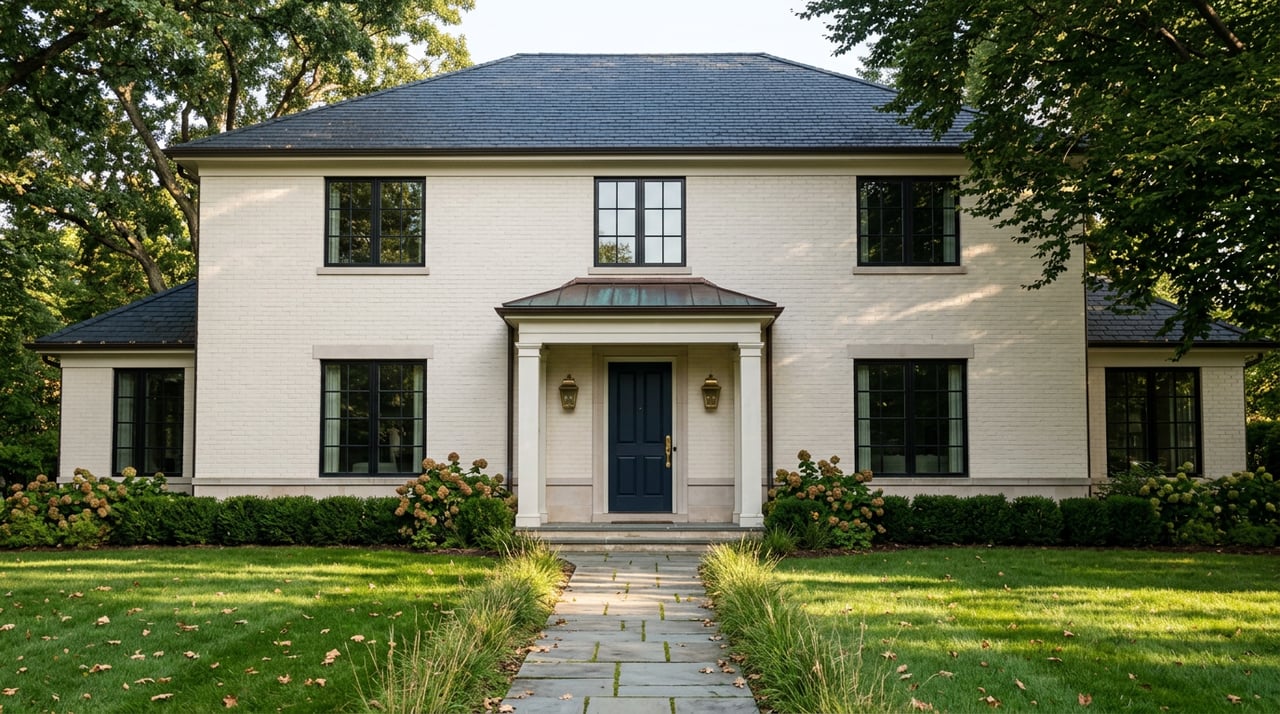
Local reporting places the next disruption in the same stretch of the boulevard, describing it as unfolding in the Meyer Circle area of Ward Parkway. A different kind of change has been rising there, floor by floor. At 6315 Ward Parkway, a nearly 10,000-square-foot modern home is under construction on the lot where a 1926 English Georgian house once stood, the former residence of Annette and Richard Bloch, co-founder of H&R Block, before it was razed in 2009. The new build, reported by the Kansas City Star via Yahoo News to carry a roughly $7 million price tag, is designed by Kansas City's sixtwentyone architecture and design and includes a pool, a pool house, five bedrooms, and an elevator.
The construction sign out front reads "Hi, Neighbors!" which tells you the builder already expected an audience. They got one. Some neighbors, like Scott Weidemeyer, who lives a few hundred feet away, called the place "cool" and said he understood the impulse behind it even if it wasn't his taste. Others were less charitable. One nearby resident described the scale as more than she wanted to see from her own backyard, saying she would have preferred less house and more vegetation. A Facebook post from a Brookside neighborhood association reportedly drew seventy or eighty comments on the project, most of them positive, but not all.
Why Nothing Here Changes Quietly
These two stories, the fountain and the mansion, aren't really about a broken bowl or a big house. They're evidence of the same underlying condition: on Ward Parkway, private and public projects alike get treated as neighborhood business, not individual decisions.
Part of that is written into the rules. Since 1996, new construction along the boulevard has required a certificate from the city's Historic Preservation Committee before it can proceed, a formal check that most Kansas City streets don't have to clear, according to Wikipedia's summary of the boulevard's history. Part of it is cultural. This is a street the American Planning Association named a Great Street in 2012, citing the passion of both residents and city government for maintaining it. When a boulevard gets treated that way officially, informally it starts getting treated that way by the people who live on it too. A builder who puts up a "Hi, Neighbors" sign before anyone asks is responding to that expectation, not creating it.
That's useful context if you're the kind of person who notices these things on your daily drive. The scrutiny isn't random. It's the toll this particular street charges for being the kind of place people care enough to argue about.
Further Down the Parkway, the Butcher Shop Everyone Is Waiting On
Head south past Meyer Circle toward the 79th Street corridor, and the story changes from marble and mansions to meat counters. The Fareway Meat Market at 79th and Ward Parkway broke ground this spring on a new, expanded building, according to KCTV5, with an opening expected later this year.
The corner has history of its own. Fareway didn't invent the site. The company entered the Missouri market in 2020 by acquiring the assets of McGonigle's, a butcher and specialty grocer that had served the same 79th and Ward Parkway corner for two generations before the sale, a fact Fareway itself noted when it announced the original opening. The new build keeps the full-service butcher counter and the McGonigle's-branded barbecue program that regulars know, just in a larger footprint. For a corner that has quietly fed the same stretch of the Ward Parkway shopping district for decades, that's not nothing. It's one more sign that even the practical, unglamorous parts of this boulevard don't get replaced without people noticing what used to be there.
One Saturday a Year, the Whole Boulevard Becomes the Race
And then there's the one disruption that's scheduled, welcomed, and closes the street on purpose. Every spring, Rock the Parkway shuts down a long stretch of Ward Parkway, from 51st Street near Loose Park south to the Wornall and Bannister Roads area, for its half-marathon and 5K. This year's race, the 17th annual, brought out more than 6,000 runners, according to KCTV5's coverage of the April 2026 event. The event benefits Children's Mercy, and organizers reported that 2025 participants raised nearly $38,000 for the hospital, whose patient of the year, five-year-old Olivia Robinson, was diagnosed with a brain tumor at age three.
It's the one closure on this list that residents actually plan around instead of stumbling into. But it belongs on the same list as the fountain, the mansion, and the butcher shop for the same reason. It's proof that this boulevard's public identity, the wide median, the historic houses, the fountains, gets used for something bigger than scenery once a year, and that the people who live along it have made peace with sharing it.
The Pattern, Not the Punch Line
None of these four things caused any of the others. But look at where they sit. Two of them landed in the same Meyer Circle stretch of the boulevard. One sits further south at the 79th Street shopping corridor. One runs the length of the whole street once a year. Different stretches, different decades of history behind each one, and yet every single story followed the same shape: something changed, and the change became public before it became final.
That's not a complaint about Ward Parkway. It's closer to a compliment, and it's also useful information if you're trying to understand what kind of street this actually is. A boulevard doesn't earn a Historic Preservation Committee requirement, a resident who calls the city about his view, or seventy Facebook comments about a construction sign, by being a place where people don't pay attention.
If you're weighing a property near the parkway and want a read on what a specific stretch of it, or a specific build like the one at 6315, actually means for long-term value, construction quality, or site conditions, that's exactly the kind of question The Pfannenstiel Group is set up to answer. Reach out, and let's talk through what you're looking at.