Look up Leawood on any major listing site and you will get a single number. In July 2026, that number was a median list price of $975,000 and $275 a square foot, drawn from the same data set that also showed active listings running from $180,000 to $4,153,049 inside one city's limits. A four-million-dollar range hiding behind one median is not a rounding error. It is a sign that the number is describing two markets and calling them one.
Zoom out and the county figure is even less useful. Johnson County's median sale price was $499,000 in June 2026, up 2.9 percent year over year, according to the Heartland MLS local market update for the county. That number tells you almost nothing about what a specific Leawood address will cost, because Leawood does not behave like one market pulled slightly upward by a few expensive outliers. It behaves like two markets that happen to share a mayor.
The Line the City Admits It Has
Leawood is served by two separate public school districts, Shawnee Mission USD 512 and Blue Valley USD 229, a fact the city states plainly on its own schools page. That alone would be worth knowing. What makes it a genuine transaction risk is that the boundary between the two is not a clean line on a map. It is drawn address by address, which means two homes a few streets apart, both comfortably inside "Leawood" as a mailing address, can sit in different districts with different attendance zones, different feeder patterns, and different resale dynamics.
Buyers who lean on the local shorthand, north Leawood for Shawnee Mission and south Leawood for Blue Valley, are using a rule of thumb that holds often enough to feel safe and fails often enough to matter. The only way to know for certain is to run the specific address through each district's own boundary tools before writing an offer, not after.
Two Leawoods at a Glance
| Older / North Leawood | Newer / South Leawood | |
|---|---|---|
| Typical era | 1950s brick ranches, many renovated or rebuilt | Master-planned luxury communities established through the 1990s |
| Representative areas | Leawood Estates, the Lee Boulevard corridor | Hallbrook Farms, Tuscany Reserve |
| School district | Shawnee Mission USD 512 | Blue Valley USD 229 |
| Typical lot story | Larger, mature-tree lots bought for the land as much as the house | HOA-platted lots with design review and shared amenities |
| Price signal | Tracks closer to the citywide median | Runs multiples of the citywide median |
What Money Buys on Each Side of the Line
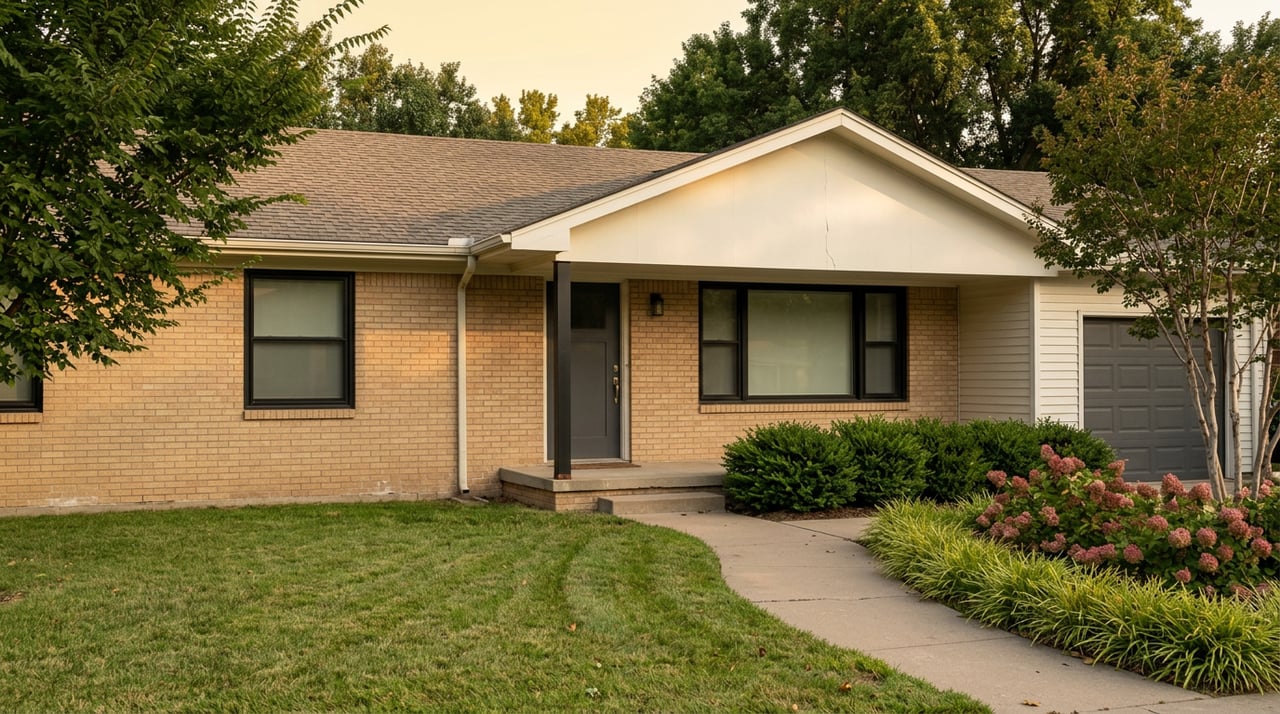
The Lee Boulevard corridor and neighboring Leawood Estates are the clearest example of the older, northern pattern. These are 1950s brick ranch neighborhoods where a meaningful share of current inventory has been expanded, updated, or purchased for the lot and rebuilt entirely. Buyers here are frequently paying for mature landscaping and a larger footprint of land as much as for the structure itself, which is exactly the kind of purchase that rewards a construction-literate walkthrough before closing.
Head south toward 119th and State Line and the story changes entirely. Hallbrook Farms traces back to 1927, when Hallmark Cards founder Joyce C. Hall bought more than 730 acres there for his family's farm; the neighborhood's homes association was formally established in 1999 to manage what has since become one of the most recognized luxury addresses in Johnson County. As of May 2026, homes in Hallbrook carried a median list price near $2.27 million, and even its lower-priced listings had a median around $2.07 million with a typical 68 days on market. That is roughly two to three times the citywide median, inside the same city.
Tuscany Reserve, also entirely in Blue Valley, tells a similar story at a different scale. Homes there have recently averaged roughly $913,000 for about 3,596 square feet, with HOA dues that cover lawn maintenance, snow removal, and trash and recycling pickup, plus access to a private lake and walking trail. New construction inside communities like Hallbrook East Village goes a step further, requiring buyers to select from custom plans or work with one of three approved builders under the community's own design standards. That is a materially different ownership experience, and a different monthly cost structure, than an updated ranch on an unrestricted lot in the north.
The ZIP Code Doesn't Fix This Either
A buyer who suspects the citywide median is misleading might reach for ZIP code data instead. Leawood spans three ZIP codes, 66206, 66209, and 66211, but a ZIP code does not resolve the problem, it repeats it at a smaller scale. In the same July 2026 listing pool that produced the citywide $975,000 median, active listings inside 66211 alone included a one-bedroom condo on Tomahawk Creek Parkway priced at $240,000 and a five-bedroom, 8,224-square-foot estate on West 118th Terrace listed at $2,485,000, both carrying the same ZIP code in the same month. A ZIP code narrows the search, but it does not substitute for knowing the school district, the subdivision, and the build era of the specific block a buyer is considering.
What This Means If You're Comparing a Ranch to a New Build
None of this is a reason to avoid one side of Leawood in favor of the other. It is a reason to stop treating "Leawood" as a single decision. A renovated ranch on a mature lot in Shawnee Mission territory and a new-construction villa inside a Blue Valley design-review community are not two points on the same price curve. They are two different products serving two different priorities: land and character in one case, turnkey new construction and shared amenities in the other.
The practical step is the same either way. Confirm the school assignment for the exact address, not the neighborhood name, using the district's own boundary lookup tools. Shawnee Mission publishes its boundary maps directly, and Blue Valley maintains its own district site with current attendance information. Do this before an offer goes in, not after inspection, since attendance boundaries can be revised over time and a name like "Old Leawood" is a helpful shorthand, not a guarantee.
FAQ
Does Leawood have one school district? No. The city is served by two: Shawnee Mission USD 512 and Blue Valley USD 229. Coverage is determined by address, not by a simple north-south split.
Are homes north of I-435 always in Shawnee Mission? Generally, older neighborhoods closer to State Line and Mission Road trend that way, but the boundary is address-specific. Confirm any address through the district's own boundary tool rather than assuming based on location alone.
Why does Leawood's median price vary so much between sources? Different platforms pull from different date ranges, sample sizes, and listing versus sold data. The bigger issue is that any single citywide number, whatever the source, is averaging a $180,000-to-$4 million-plus range into one figure that does not describe any specific block.
Comparing a mid-century ranch on Lee Boulevard to a new build in Hallbrook or Tuscany Reserve is not really a price question. It is a question about what kind of ownership experience, school assignment, and long-term value you're actually buying, and that only shows up once you look past the citywide median to the specific address. If you want that kind of address-level read on a Leawood property, or want to weigh a renovation candidate against new construction with a construction-minded eye, The Pfannenstiel Group is a good place to start that conversation.
This article is general information, not legal, tax or financial advice. Consult a qualified professional about your situation.