A Liberty, Missouri mailing address and a 64068 ZIP code will tell you where your mail goes. They will not tell you whether the parcel actually sits inside the City of Liberty. That distinction sounds like a technicality until you're the buyer who assumed city water and sewer, or the seller whose survey shows the lot line falls in unincorporated Clay County instead. The city boundary, the Liberty school district boundary, and the county line all run through the same stretch of the Northland, and they don't follow each other street by street.
That mismatch matters more this year than it has in the past, because most of Liberty's new construction is happening exactly where those lines get complicated: the southern and eastern edges of town, where subdivisions are still being platted and annexed in phases rather than sitting inside a boundary that was settled decades ago.
The Line the Listing Won't Show You
Here's the mechanism. Three separate boundaries overlap in Liberty: the municipal city limit, the Liberty school district attendance boundary, and the Clay County line. Each one was drawn for a different purpose and at a different time, so none of them defer to the others. A parcel can carry a Liberty postal address and still fall just outside city limits, which means it depends on Clay County rather than the City of Liberty for permit jurisdiction, and possibly for water, sewer, and trash service too.
For a buyer, that's not an abstract civics lesson. It changes who inspects a remodel before you close, who bills you for utilities after you close, and which taxing district actually shows up on your bill. Two houses that look identical online, same ZIP code, same school name in the listing description, can answer those four questions differently depending on which side of an invisible line each one sits on.
Growth Is Happening Right Where the Lines Blur
This isn't a fringe scenario. Liberty's active residential growth is concentrated on the city's southern and eastern edges, the same areas where annexation and boundary work tends to lag behind construction. The city's own list of residential projects includes a 52.7-acre development along Withers Road, just south of the Liberty Community Center, being built out in phases with lots still available in Phase 3 as of the most recent update. A second project nearby, 16 acres north of Buckingham Drive, is platted for 29 single-family lots with a private pocket park as its shared amenity. Homestead Hills, one of the larger active communities, is being built by a group of builders working the same subdivision simultaneously, including Aspen Homes, Hearthside Homes, Olympus Custom Homes, and Phillips Construction Services.
Growth at the edges isn't the whole story, though.
One of the city's current residential projects is an infill parcel at the corner of Kansas and Water Streets in historic downtown Liberty, the site of a building collapse in 2016, now being redeveloped rather than left vacant.
That detail matters because it shows Liberty adding housing stock in two directions at once: new subdivisions expanding the edges where boundaries are still being sorted out, and infill projects filling gaps inside the historic core where the city limit was never in question. Buyers comparing "new construction in Liberty" need to know which kind of new they're actually looking at.
Three Housing Stocks, One Blended Number
Liberty's median price is a single number describing three fundamentally different products.
The first is pre-1970 housing stock within walking distance of the historic Liberty Square, bungalows and early two-stories where character and lot position drive value more than floor plan. These homes often carry original systems: knob-and-tube or galvanized wiring, cast-iron drain lines, and electrical panels sized for a smaller era of appliances. None of that makes them a bad buy, but it changes what an inspection will find and what a negotiation should account for.
The second is the 1980s-through-early-2000s cul-de-sac subdivisions that make up the majority of Liberty's for-sale inventory in any given month. These are the homes most buyers picture when they picture Liberty: established trees, HOA presence that varies by subdivision, and roofs and HVAC systems that are aging into replacement territory. That age isn't a defect. It's a negotiating point if you can document it.
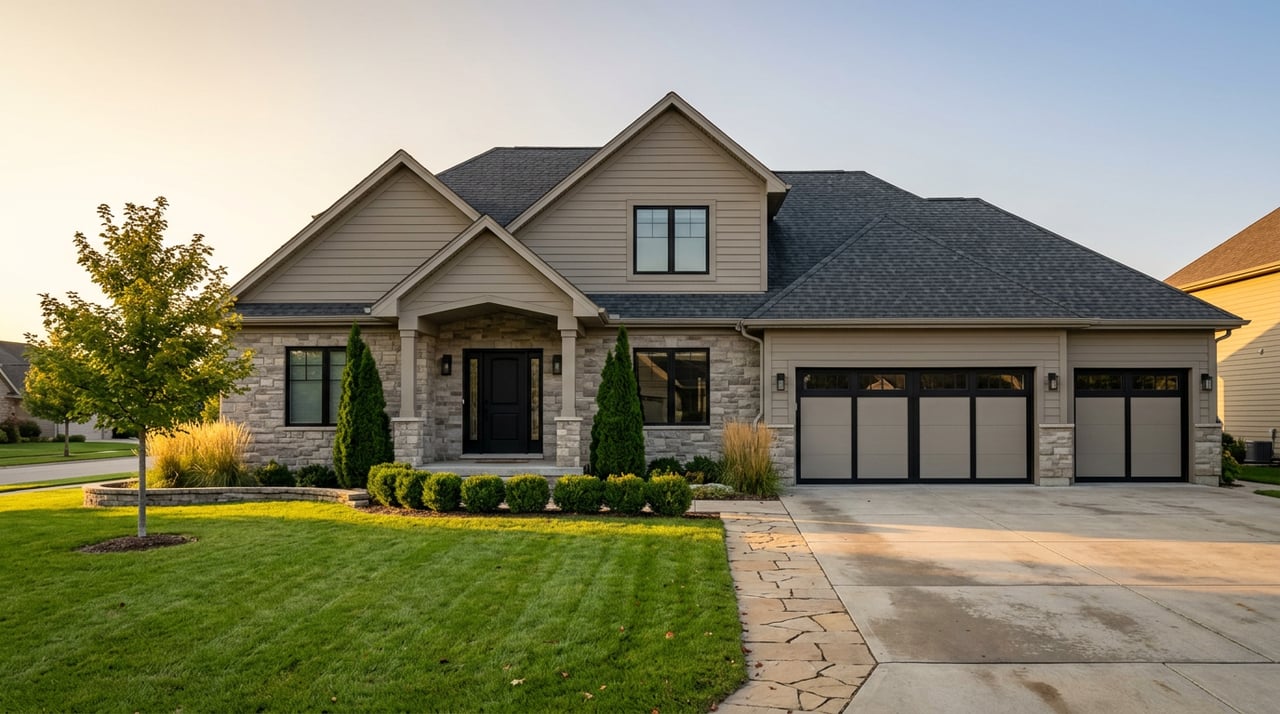
The third is active new construction, concentrated in communities like Ella's Crossing, where D.R. Horton is building open-concept ranch and two-story plans generally priced from the $375,000s into the $500,000s, and in Clay Meadows and Homestead Hills, where multiple builders are working side by side and pricing runs from roughly $415,000 to the high $800,000s depending on lot, elevation, and finish level.
Blend all three together and you get the citywide number: as of September 2026, Liberty's median list price sat at $425,000, or about $196 per square foot, both down slightly from the prior year. Sold prices tell a slightly different story. Over the three months ending in May 2026, the median sale price across Liberty was $370,000 at roughly $175 per square foot, meaningfully below the list-price figure. That gap between what sellers are asking and what buyers are actually paying is worth sitting with. It suggests list prices have room to come down in negotiation, particularly on the older or more dated end of the inventory, even in a market where homes are still moving at a reasonable pace.
That pace is its own small contradiction. Median days on market in September 2026 came in at 32, down from the same month a year earlier, even as price per square foot softened over the same period. A market where homes sell faster while asking prices per square foot ease slightly isn't a market cooling from lack of interest. It reads more like sellers pricing a touch more conservatively upfront, and buyers responding by acting quickly once a home is priced right.
What Skipping the Boundary Check Actually Costs
The boundary question and the housing-stock question intersect at inspection and permitting. A downtown bungalow with an unpermitted addition is a different problem depending on whether the City of Liberty or Clay County holds the permit history, since the two departments don't necessarily share records or enforcement priorities. A newer subdivision home near the edge of town can have the same issue in reverse: work permitted through the county before an annexation, now sitting inside city limits with a different inspector's standards attached going forward.
For cul-de-sac inventory from the 1980s and 1990s, the practical risk is simpler but just as real. HOA presence and the strength of governing documents vary subdivision by subdivision, and an aging roof or HVAC system that hasn't been flagged in a listing description can become a five-figure conversation at inspection if it isn't priced in ahead of time.
What to Confirm Before You Write an Offer
A few checks take an afternoon and prevent a surprise at closing:
- Confirm whether the parcel sits inside Liberty city limits or unincorporated Clay County, through the title company or county parcel records, rather than assuming based on the mailing address.
- Confirm the specific school assigned to the address, since the school district boundary doesn't track the city limit.
- Confirm the utility provider for water and sewer, and whether service is municipal or county-administered.
- Confirm permit jurisdiction for any additions, finished basements, or major alterations, and ask for the permit history rather than assuming the seller's description is complete.
- If the property sits in an HOA, request the governing documents before you're under contract, not after.
None of these steps are complicated. They just aren't visible from a listing photo or a median-price headline, which is exactly why they get skipped.
Where Construction Knowledge Actually Pays Off
This is the kind of due diligence that benefits from someone who has spent time on the build side, not just the sales side. Understanding why a permit history looks the way it does, or why an older electrical panel matters more in one negotiation than another, comes from having evaluated site conditions and construction quality directly rather than from reading a listing sheet. That's the lens Joseph Pfannenstiel and the team bring to Liberty transactions, whether the property in question is a bungalow near the square, a cul-de-sac home from the 1990s, or a new build still going up on Withers Road.
If you're comparing Liberty neighborhoods and want a clear read on what a specific address actually is, not just what its ZIP code suggests, Joseph Pfannenstiel can walk the boundary, the permit history, and the build quality with you before you write an offer.
Frequently Asked Questions
Does a 64068 ZIP code guarantee my home is zoned for Liberty schools? No. The Liberty school district's attendance boundary and the municipal city limit are drawn separately, so a Liberty ZIP code alone doesn't confirm the school assignment. Ask for the specific address confirmation rather than relying on the ZIP code or general area reputation.
Can two homes on the same street really be in different jurisdictions? Yes. Because the city limit, the county line, and the school boundary don't always follow the same path, adjacent parcels can fall on different sides of one or more of those lines, particularly in areas that have been annexed in phases.
Is older housing stock near the Liberty Square a risk to avoid? Not inherently. It simply requires a different kind of due diligence, focused on electrical, plumbing, and permit history rather than the newer-construction concerns that come with subdivisions still being built out.